


22 June 2026, Motihari, Bihar
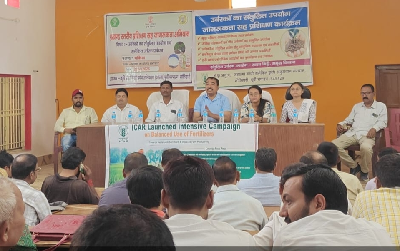
As part of the nationwide Khet Bachao Abhiyan–2026, ICAR–Mahatma Gandhi Integrated Farming Research Institute, Motihari, in collaboration with the Agricultural Technology Management Agency (ATMA), organized a farmer training-cum-awareness programme on balanced fertilizer use, soil health management, and climate-resilient agriculture at Mehsi Block, East Champaran district, Bihar.
The programme represented a joint effort of ICAR-MGIFRI and ATMA to strengthen farmer awareness on sustainable agricultural practices and promote soil-health-centered farming systems. ATMA, a district-level extension platform of the Department of Agriculture, Government of Bihar, plays a vital role in disseminating agricultural technologies, enhancing farmer capacity, and facilitating the adoption of improved farming practices at the grassroots level.
Addressing the gathering, the objectives of the Khet Bachao Abhiyan were highlighted, with emphasis on the importance of biofertilizers, biopesticides, organic manures, and Integrated Farming System (IFS) approaches for restoring soil health and reducing excessive dependence on agrochemicals. It was stressed that sustainable agriculture begins with healthy soils and balanced nutrient management. The collaborative efforts of ICAR-MGIFRI and ATMA in delivering scientific knowledge directly to farmers through field-based awareness campaigns were also appreciated.
Participants were further informed about the vital link between healthy soils, healthy crops, healthy livestock, and healthy people. It was emphasized that the quality of animal feed largely depends on soil health and the production of nutrient-rich fodder. Healthy soils support the production of nutritious crops and fodder, which in turn contribute to healthier livestock and improved nutrition and well-being of farming families. Farmers were encouraged to view crop production, livestock management, and nutrition as interconnected components of sustainable farming systems.
During the technical session, scientists highlighted the importance of green manuring through Sesbania (Dhaincha) for improving soil organic matter, enhancing microbial activity, and reducing fertilizer requirements in rice-based systems. Farmers were encouraged to cultivate Dhaincha before rice transplantation and incorporate the biomass into the soil to improve nutrient availability and long-term soil fertility.
Participants were also sensitized about the consequences of removing fertile topsoil for brick-making and the harmful effects of crop residue burning. Scientists explained that fertile topsoil contains valuable organic carbon and nutrients accumulated over decades, and its removal or destruction significantly reduces soil productivity. Similarly, residue burning destroys beneficial microorganisms, accelerates nutrient losses, and weakens soil structure. Farmers were encouraged to conserve topsoil, recycle crop residues, and adopt soil-building practices to sustain agricultural productivity.
Scientists further emphasized the role of crop diversification and the inclusion of legumes such as green gram in cropping systems. Legume crops biologically fix atmospheric nitrogen, improve soil fertility, reduce fertilizer requirements in succeeding crops, and enhance overall system sustainability.
The programme also highlighted the importance of crop planning and crop calendars for maximizing productivity and reducing climate-related risks. Farmers were advised to select crop varieties according to sowing windows and local climatic conditions to improve cropping intensity, resource-use efficiency, and farm profitability.
Special emphasis was placed on the promotion of soil-test-based nutrient management, balanced fertilizer application, and Integrated Farming Systems as practical pathways for climate-resilient agriculture. Scientists encouraged farmers to undertake regular soil testing and apply nutrients according to crop requirements and soil fertility status.
The programme concluded with a strong message that soil testing, balanced fertilization, green manuring, crop diversification, residue recycling, and protection of fertile topsoil are the cornerstones of healthy soils and sustainable agriculture. Farmers appreciated the practical demonstrations and scientific guidance provided through the joint efforts of ICAR-MGIFRI and ATMA and expressed their willingness to adopt the recommended practices during the upcoming cropping season.
The event demonstrated how research institutions and extension agencies can work shoulder-to-shoulder to accelerate farmer awareness, strengthen technology dissemination, and promote sustainable agricultural development under the Khet Bachao Abhiyan.
A total of 79 farmers actively participated in the programme and interacted with scientists and extension personnel on issues related to soil fertility management, N-use efficiency, sustainable agriculture, and profitable farming systems.
(Source: ICAR–Mahatma Gandhi Integrated Farming Research Institute, Motihari, Bihar)


Like on Facebook
Subscribe on Youtube
Follow on X X
Like on instagram