


23 June 2026, Motihari, Bihar
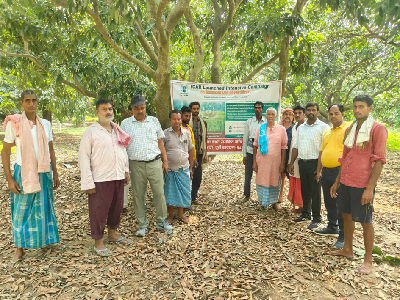
As part of the nationwide Khet Bachao Abhiyan–2026, ICAR–Mahatma Gandhi Integrated Farming Research Institute, Motihari organized a farmer awareness programme on scientific nutrient management in litchi orchards for growers from different blocks of East Champaran district, Bihar. The programme focused on balanced fertilizer use, soil health management, micronutrient nutrition, and sustainable orchard management practices for improving litchi productivity and fruit quality.
Litchi, popularly known as the “Queen of Fruits,” is one of the most remunerative fruit crops cultivated in Bihar and other parts of northern India. Scientists highlighted that maintaining balanced nutrition is essential for sustaining fruit yield, quality, orchard health, and long-term soil fertility.
The participants were apprised of the importance of adequate nutrient supply in ensuring higher productivity and better fruit quality in litchi. The discussion underscored that nutrient deficiencies, soil fertility degradation, and imbalanced fertilizer use can significantly impact fruit yield and the economic viability of litchi orchards.
Dr. Purbey informed farmers that every one tonne of litchi fruit removes approximately 2.2 kg nitrogen (N), 2.2 kg phosphorus (P₂O₅), 6.6 kg potassium (K₂O), 1.6 kg calcium (CaO), and 1.1 kg magnesium (MgO) from the soil. With India's average litchi productivity of about 7.65 tonnes ha⁻¹, orchards annually remove nearly 16.8 kg N, 16.8 kg P₂O₅, 50.5 kg K₂O, 12.2 kg CaO, and 8.4 kg MgO per hectare. He emphasized that these nutrients must be replenished through balanced fertilization and organic nutrient sources to sustain productivity and fruit quality.
Farmers were informed that fertilizers contribute nearly 50–70% of the final fruit yield, and improper nutrient management often results in reduced fruit size, poor fruit quality, lower yields, and higher susceptibility to insect-pests and diseases. At the same time, excessive fertilizer use can increase production costs, reduce nutrient-use efficiency, and contribute to environmental pollution.
Scientists recommended integrating farmyard manure (FYM), biofertilizers, organic manures, and chemical fertilizers according to tree age and nutrient demand. Special emphasis was also given to micronutrient management. Farmers were advised to undertake foliar sprays whenever deficiency symptoms appear: (i) Zinc: 0.2% Zinc Sulphate spray during February–March; (ii) Copper: 0.2% Copper Sulphate spray during February–March; (iii) Manganese: 0.2% Manganese Sulphate during vegetative growth; (iv) Boron: 0.2% Boric Acid during fruit development. Scientists explained that micronutrients play a crucial role in flowering, fruit set, fruit development, fruit quality, and overall orchard health.
The programme also highlighted the importance of proper fertilizer timing. During the pre-bearing stage, urea should be applied in three equal splits during February–March, June–July, and August–September, whereas bearing trees should receive urea in two equal splits, one during mid-February and the second after fruit set in April. FYM, SSP, and MOP should preferably be applied during December.
Farmers were advised that fertilizers should not be placed near the trunk because most active feeder roots remain concentrated in the upper 60–90 cm soil layer beneath the canopy. Instead, fertilizers should be applied in circular bands under the canopy and lightly incorporated into the soil for efficient nutrient uptake.
The participants were informed that sustainable litchi production depends on maintaining a balance between soil fertility, plant nutrition, and orchard management. Farmers were encouraged to adopt soil-test-based fertilizer recommendations, maintain adequate soil organic carbon through the application of organic manures, and integrate biological nutrient sources to enhance long-term orchard productivity.
The programme concluded with a strong message that balanced fertilization, micronutrient management, organic nutrient recycling, and soil-health-centered orchard management are essential for achieving higher litchi productivity, superior fruit quality, and sustainable orchard-based livelihoods.
A total of 33 farmers participated in the programme and actively interacted with scientists on nutrient management, soil health, and sustainable litchi production technologies under the Khet Bachao Abhiyan–2026.
(Source: ICAR–Mahatma Gandhi Integrated Farming Research Institute, Motihari, Bihar)


Like on Facebook
Subscribe on Youtube
Follow on X X
Like on instagram