

For Mrs. Bindia Khasia, a 45-year-old woman farmer from Pedla Punjee in Hailakandi district, Assam, integrating different farm enterprises has opened new avenues for income generation and livelihood security. With technical guidance and support from ICAR-KVK Hailakandi, she adopted an integrated fish-based farming system that brought together fish culture, duck rearing, backyard poultry and horticultural crops, including arecanut and Assam lemon.
The farming system was designed to make better use of the available land, water resources, farm residues and household labour, while creating multiple sources of income. At the heart of the system was the fish pond, which served not only as a source of fish but also as a central component around which other farm activities were integrated. Ducks and backyard poultry were reared alongside fish culture, while arecanut and Assam lemon were planted around the pond and farm boundaries, making productive use of available space.
An important feature of the system was the recycling of farm resources. Droppings from ducks and poultry were utilised as organic inputs, allowing nutrients to be recycled within the farm and reducing dependence on external inputs. The integration of crops, fish and livestock created a more efficient use of available resources, with different components complementing one another rather than functioning as separate activities.
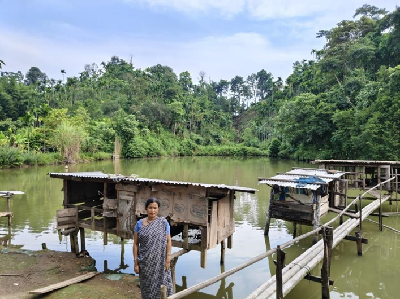
For Mrs. Bindia, the integrated approach also offered the advantage of having several income-generating activities within and around the household. Fish, poultry, ducks and horticultural crops provided diversified sources of farm produce and reduced dependence on a single enterprise. The proximity of these activities made the model particularly suitable for women farmers, enabling her to participate more actively in farm management, decision-making and income-generating activities while making effective use of family labour.
The impact of the intervention is reflected in the substantial improvement in her annual income. Before adopting the integrated farming system, Mrs. Bindia earned approximately ₹1.50 lakh annually. Following the intervention, her annual income increased to around ₹3.00 lakh, representing an increase of nearly 100%.
Beyond the increase in income, the integrated system has strengthened the family's access to diverse farm produce, contributing to improved household food and nutritional security through the availability of fish, poultry and duck products, along with horticultural produce. By combining multiple enterprises within a single farming system and making better use of available resources, Mrs. Bindia has turned her farm into a more diversified and productive livelihood base.
Her journey demonstrates how women-friendly, integrated farming technologies can transform small farm resources into multiple livelihood opportunities. With scientific guidance from ICAR-KVK Hailakandi and the effective integration of fishery, livestock and horticulture, Mrs. Bindia Khasia has emerged as an example of how diversified farming can enhance income, resource efficiency and household livelihood security.
(Source: ICAR-Agricultural Technology Application Research Institute, Zone - VI, Guwahati, Assam)


फेसबुक पर लाइक करें
यूट्यूब पर सदस्यता लें
X पर फॉलो करना X
इंस्टाग्राम पर लाइक करें