

India’s rich agro-climatic diversity offers immense scope for cultivating medicinal and aromatic plants, creating opportunities not only for farm-based livelihoods but also for processing, value addition, branding and marketing. With growing demand for natural and herbal products, medicinal plants are emerging as a promising avenue for rural entrepreneurship and income diversification, particularly for women. The story of Sita Herbal Farm in Sitapur district of Uttar Pradesh is a compelling example of how training, collective action and institutional support can transform a small initiative into an emerging women-led enterprise.
The journey began with Smt. Sita, who was looking for a means to build an independent livelihood beyond private tuition. Her efforts took a new direction after she participated in training on natural farming and visited Vishva Shakti Agro-Producer Company, a natural farming-based Farmer Producer Organisation (FPO). The exposure introduced her to the possibilities of medicinal plant cultivation, collective farming and organised marketing.
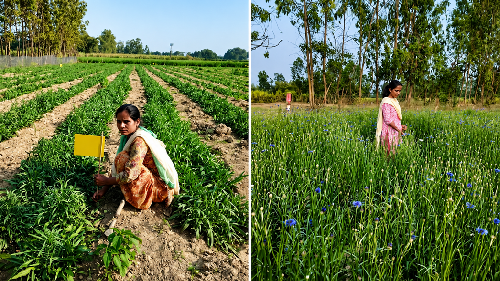
Inspired by the experience, 18 women farmers from three blocks came together after undergoing a 15-day training programme on natural farming at Khairabad. The women subsequently received training on cultivating medicinal plants under natural farming conditions. What began as a learning experience soon developed into a collective endeavour, as the women realised that working together could help them overcome one of their biggest challenges—limited access to land.
Most of the participating women did not own agricultural land. Instead of allowing this constraint to halt their efforts, they adopted a cluster farming approach. Smt. Sita leased approximately one acre of land and used it to anchor the group's initial cultivation activities. Her initiative provided the women with a practical starting point and demonstrated that land constraints could be addressed through collective action and innovative arrangements.
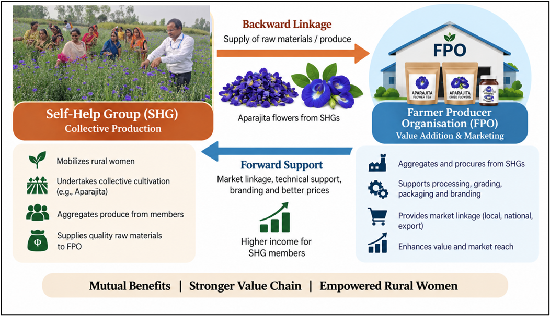
The women organised themselves into the Self-Help Group (SHG) Mahila Sashaktikaran and began cultivating medicinal plants such as Blue Corn and Aparajita. Their produce was subsequently linked with an FPO, creating a structured pathway from production to aggregation, branding, packaging and market sale. This linkage enabled the women to move beyond individual cultivation and become part of an organised value chain, strengthening their collective bargaining power and access to markets.
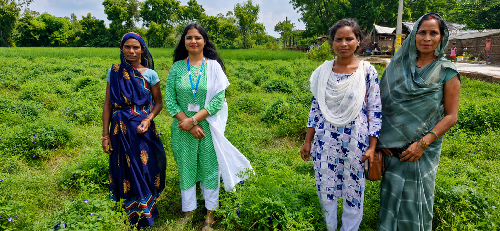
The institutional support provided by Krishi Vigyan Kendras (KVKs) and the State Block Mission Manager further strengthened the initiative. The women received technical guidance on natural farming and medicinal plant cultivation, while support for branding and packaging helped them move towards developing their own market identity. Regular interaction with KVK experts also enabled the group to access technical advice and explore market opportunities. The group has also developed an active social media presence, helping create greater visibility for its products and activities.
The results have been encouraging. From the initial 18 women, the group has expanded to around 50–100 farmers, with an ambitious target of reaching 250 members. The area under cultivation is also expected to expand progressively from the initial one acre to nearly 30–60 acres as more women join the cluster. Each participating farmer reportedly produces around four quintals of medicinal plants annually approximately two quintals of Blue Corn and two quintals of Aparajita. With reported sale prices of around ₹70,000 per quintal for Blue Corn and ₹65,000 per quintal for Aparajita, the enterprise generates an estimated gross annual income of about ₹2.6 lakh per farmer, with reported net income of approximately ₹1.5 lakh.
The benefits extend beyond farm income. Several women associated with the initiative are also working as Krishi Sakhi, helping disseminate natural farming practices among other farmers. For their extension-related work, they receive a fixed stipend of ₹5,000 per month, providing an additional source of income and creating opportunities for women to take on grassroots agricultural leadership roles.
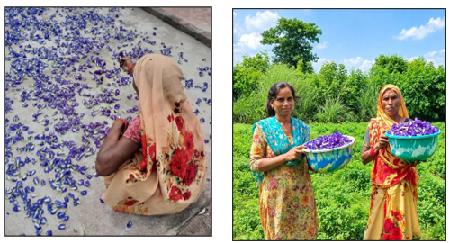
An equally significant outcome has been the productive utilisation of barren and previously unused land. Inspired by Smt. Sita’s initiative, several women have begun bringing such land under cultivation. The transformation has expanded the area devoted to agriculture while improving land utilisation and vegetation cover and creating additional livelihood opportunities for women in the process.
At the heart of the initiative is a simple but effective SHG–FPO linkage. The women farmers come together through the SHG, undertake cluster-based cultivation and collectively produce medicinal plants. Their produce is then aggregated and connected with the FPO, which supports branding, packaging, value addition and marketing. In this way, the SHG provides a reliable production base and backward linkage to the FPO, while the FPO provides forward market linkage and enables the women to reach organised markets that would be difficult to access individually.
The journey of Sita Herbal Farm thus demonstrates how a small beginning can evolve into a broader model of women-led agricultural entrepreneurship. What started with 18 women, limited access to land and a desire to learn has grown into a collective enterprise combining natural farming, medicinal plant cultivation, institutional support, branding and organised marketing. More importantly, the initiative is enabling women to move from being individual, resource-constrained farmers to becoming active participants in an organised agricultural value chain.
Through the convergence of SHGs, FPOs and KVKs, the women of Sita Herbal Farm are not merely cultivating medicinal plants they are cultivating new possibilities for livelihood, enterprise and leadership. Their experience demonstrates that when knowledge, collective action and market access come together, even constraints such as limited land ownership can become stepping stones towards sustainable rural entrepreneurship and women's economic empowerment.
(Source: ICAR-Agricultural Technology Application Research Institute, Kanpur)


फेसबुक पर लाइक करें
यूट्यूब पर सदस्यता लें
X पर फॉलो करना X
इंस्टाग्राम पर लाइक करें