

At 62, Mrs. Vihuli of Niuland Town in Nagaland has turned what was once a small-scale vermicomposting activity into a promising livelihood enterprise. Her journey from producing a modest quantity of compost for limited returns to building a diversified vermicomposting enterprise is a story of how scientific knowledge, hands-on training and timely institutional support can transform a simple farm activity into a sustainable source of income.
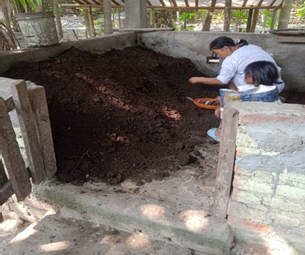
Before associating with Krishi Vigyan Kendra (KVK), Dimapur, Mrs. Vihuli practiced vermicomposting on a limited scale using a single portable vermibag measuring 6 × 4 × 2 ft. With limited technical knowledge and inadequate production practices, she harvested vermicompost only once a year. Her annual production was around 290 kg, which she sold at ₹30 per kg, earning a gross return of about ₹8,700. After accounting for the production cost, her net income was only ₹1,300, with a benefit-cost ratio of 1.17:1.
A significant change came in December 2024, when Mrs. Vihuli came in contact with KVK Dimapur. Recognizing the potential to improve her enterprise, the KVK provided her with hands-on training in scientific vermicompost production. She was guided on improved bed management, moisture regulation, timely feeding of organic materials and scientific harvesting techniques. The training also introduced her to additional income opportunities through the collection and marketing of vermiwash, a nutrient-rich liquid organic input, as well as the multiplication and sale of earthworms.
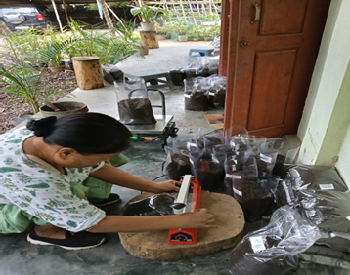
To support the expansion of her activity, KVK Dimapur provided her with an additional portable vermibag measuring 8 × 4 × 2 ft. Equipped with new knowledge, improved practices and continued technical guidance, Mrs. Vihuli expanded her enterprise from one to two vermibags in 2025.
The results were remarkable. By adopting scientific production and management practices, she increased her output to around 610 kg of vermicompost per harvest and was able to undertake three harvests in a year. Her total vermicompost production reached 1,830 kg in 2025, generating ₹54,900 at ₹30 per kg. She further diversified her income by producing 50 litres of vermiwash, earning ₹1,250, and selling 4 kg of earthworms at ₹2,000 per kg, generating another ₹8,000.
Together, these activities brought her total gross income to ₹64,150 in 2025. Against a total production cost of ₹19,300, Mrs. Vihuli earned a net income of ₹44,850, raising her benefit-cost ratio from 1.17:1 to an impressive 3.32:1.
Beyond the numbers, the transformation has brought greater confidence and economic independence to Mrs. Vihuli and strengthened her standing within the local farming community. What began as a modest activity has evolved into a diversified enterprise that makes productive use of farm waste while generating valuable organic inputs and additional livelihood opportunities.
Mrs. Vihuli’s journey demonstrates that even a small enterprise can create significant economic impact when backed by the right knowledge, technology and institutional handholding. Her success has made her a role model for farmers in the region, encouraging others to look at vermicomposting not merely as a means of producing organic manure, but as a viable and sustainable income-generating enterprise.
Her story is a compelling example of how technology transfer and capacity building at the grassroots can turn waste into wealth while promoting recycling of farm residues, strengthening livelihoods and contributing to more environmentally sustainable agriculture.
(Source: ICAR-Agricultural Technology Application Research Institute, Zone-VII, Umiam, Meghalaya; ICAR Research Complex for NEH Region, Nagaland Centre, Medziphema, Nagaland)


फेसबुक पर लाइक करें
यूट्यूब पर सदस्यता लें
X पर फॉलो करना X
इंस्टाग्राम पर लाइक करें