


Background
Krishi Vigyan Kendras (KVKs) are key frontline extension institutions in India, operating at the district level to strengthen research-extension linkages and empower farmers with scientific knowledge and skills. Their origin traces back to the Education Commission (1964–66), which emphasized vocational agricultural education. Based on this, ICAR established KVKs as centres for training farmers, rural youth, and extension personnel. A committee chaired by Dr. Mohan Singh Mehta (1973-74) laid the foundation for their nationwide expansion.
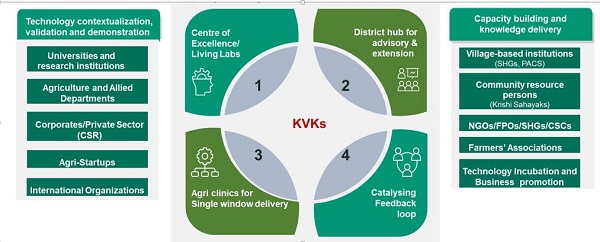
Today, India has a network of 731 KVKs covering 638 rural districts, with the first established in Puducherry in 1974. Over time, KVKs have evolved from training centres to “Single Window Agricultural Knowledge, Resource and Capacity Development Centres” with following objectives:.
Objectives
- Assessment and demonstration of agricultural technologies on the farmers’ field for their application and feedback..
- Capacity development through skilling and training of farmers, farm women, youth and extension functionaries.
- Act as an information and knowledge centre for providing diagnostic and farm advisories to farmers and other stakeholders.
- Production of quality seeds, planting materials and other technological inputs for availability to the farmers.
- Develop convergence and partnership with agriculture related ongoing schemes and programs of different departments and organizations on national priorities.
- Awareness creation and community mobilization on various issues related to agriculture & allied sectors through innovative extension activities including use of ICT and other media.
Significant Achievements
- KVKs have accelerated agricultural development through technology assessment, demonstrations, and need-based training, leading to higher adoption of improved varieties, climate-smart practices, and integrated farming systems.
- The outreach of KVKs has expanded significantly, with farmer engagement increasing from 1% in 2003-04 to 18.8% in 2024–25.
- Initiatives like Cluster Frontline Demonstrations have boosted pulses and oilseeds production, while efforts in crop residue management have helped reduce stubble burning about 86% in 2025 (compared to 2020), with notable declines in Punjab (~94%).
- KVKs are promoting natural farming, FPOs, and skill development for youth and women has strengthened livelihoods, highlighting the vital role of KVKs in sustainable and inclusive agricultural growth.
- Providing Agro-advisories through Kisan Sarathi portal, with over 2.75 crore registered farmers and around 4.2 crore advisories sent annually.
- Supporting sustainable agriculture through soil testing services
- Catalyzing Technology Adoption through Critical Resources such as production and supply of quality technological products/inputs to farmers. Further, 95 seed hubs established in KVKs to boost the production and supply of quality seeds of major pulse crops.
Contribution of KVKs in Formulation of State Policies
KVKs have played a key role in shaping state-level agricultural policies by enhancing productivity and guiding public investments. Key contributions include:
- Kerala: KVK Pathanamthitta and Alappuzha designated as State Resource Centres for jackfruit-based entrepreneurship and agro-processing.
- Lakshadweep: Declared fully organic with KVK-led certification support.
- Maharashtra: Farm pond technology scaled as a state programme.
- Bihar: Climate Resilient Agriculture across all districts; Nutri-Garden expanded to 18,000 Anganwadi centres.
- Jharkhand: Bora Bandi technology adopted in ~500 villages for diversification.
- West Bengal: Land shaping in Sundarbans increased cropping intensity (270%) and income (up to ₹4 lakh/ha), scaled over 2,000 ha.
KVK performance has been independently evaluated by National Institute of Labour Economics Research and Development (2015), a NITI Aayog Institute and International Food Policy Research Institute (2019); key findings are summarized below:
Impact of KVK (NILERD-2015)
- Each KVK covers ~43 villages and 4,300 farmers; ~80% villages within 10 km.
- Strong field focus: off-campus activities dominate KVK interventions.
- High responsiveness: ~96% farmer queries addressed.
- Impact: 42% technologies increased productivity, 33% income, 20% reduced drudgery.
- Entrepreneurship: ~100 trained/year per KVK; ~25% start ventures.
- Adoption: ~80% farmers modified practices post-training.
- Competitive edge: strong research-extension linkages and location-specific interventions.
Impact of KVK (IFPRI)
- Additional net income: ₹3,568/ha through KVK interventions.
- High ROI: ~8:1 to 12:1, indicating cost-effective extension.
- Outreach growth: farmer access increased from 1% (2003–04) to 5.34% (2013–14).
- Strong multiplier effect: 1 trained farmer reaches ~30 others.
Way forward
- KVK need to transform through comprehensive administrative and financial is imperative to realize the principle of “One Nation-One KVK-One Team.”
- Reimagining KVKs as skill and incubation hubs to foster agri-entrepreneurship, empower youth and women, and strengthen sustainable livelihoods.
- transformed KVK system can serve as a model for other developing nations, particularly in the context of South-South cooperation, showcasing India’s leadership in participatory, technology-driven, and scalable extension approaches.
- A transformed KVK system will drive a future-ready agricultural ecosystem aligned with Viksit Bharat @2047, ensuring inclusive growth, technology adoption, and higher farmer incomes. Further, this model can serve for other developing nations, showcasing India’s leadership in participatory, technology-driven, and scalable frontline extension for South-South cooperation.


फेसबुक पर लाइक करें
यूट्यूब पर सदस्यता लें
X पर फॉलो करना X
इंस्टाग्राम पर लाइक करें