


21 August 2026, Tamil Nadu
ICAR–National Research Centre for Banana, Tiruchirappalli, celebrated its 33rd Foundation Day and Kisan Mela today with the theme “Super El Niño: Mitigation in Banana-Based Cropping System.” The programme brought together scientists, farmers, entrepreneurs, exporters and other stakeholders for discussions on climate-resilient banana cultivation and strategies to address the emerging challenges posed by climatic variability.
The Chief Guest, Dr K. Balachandra Hebbar, Director, ICAR–Central Plantation Crops Research Institute, Kasaragod, Kerala, who attended the programme as the, highlighted soil, plants and atmosphere as the three major components influencing agricultural production. While farmers have limited control over atmospheric and climatic conditions, he emphasised that soil health, crop selection and the choice of quality planting material can be effectively managed to reduce production risks. He advocated intercropping over monocropping in perennial crops to create a favourable microclimate and minimise the adverse effects of climatic variability, including El Niño events.
In his presidential address, Dr R. Selvarajan, Director, ICAR-NRCB, highlighted the institute’s recent achievements in varietal development, conservation, crop protection, mechanisation and export promotion. He announced the release of two new banana varieties, Kaveri Thangam and Kaveri Nadan, at the institute level.
Kaveri Thangam is a premium-quality banana variety distinguished by its unique aroma, high consumer acceptance and yellow pulp rich in provitamin A, with a content of 1,090 µg/100 g fresh pulp, nearly ten times higher than conventional varieties. Kaveri Nadan, a Pacha Nadan type, is a high-yielding variety with approximately 100% higher yield. Planting material of both varieties has already been distributed to 126 farmers across Tamil Nadu and other major banana-growing states.
Dr Selvarajan also highlighted the collection and conservation of 33 new banana germplasm accessions and five Musa species, strengthening the institute’s efforts towards conserving banana genetic diversity. He informed that Integrated Fusarium Wilt Management is being implemented at 17 locations in Burhanpur, Madhya Pradesh, and four locations in Dasanur, Jalgaon, Maharashtra.
Highlighting efforts to expand export opportunities, he stated that an ICAR-NRCB–APEDA team had inspected facilities in Jalgaon for facilitating banana exports to Russia. The possibility of exporting bananas from Tamil Nadu to Russia through Cochin Port is also being explored.
A significant technological achievement highlighted during the programme was the development of a central-core banana stem juice extraction machine, designed on the lines of a sugarcane juice extraction machine. The technology has the potential to generate new entrepreneurial opportunities for self-help groups and street vendors by enabling the extraction and sale of banana stem juice.
The Guests of Honour Shri E. Aravazhi, Director, Coconut Development Board, Coimbatore; Dr G. J. Janavi, Dean, HC&RI (Women), TNAU, Tiruchirappalli; Dr K. Annadurai, Dean, ADAC&RI, TNAU, Tiruchirappalli; and Dr M. Govindaraju, Director, Centre for Climate Change Research, Bharathidasan University, Tiruchirappalli spoke on the implications of Super El Niño and climate variability for agriculture. They stated that Super El Niño is a natural climatic phenomenon associated with changes in Pacific Ocean conditions and may lead to extreme weather events, including floods and droughts. They highlighted the increasing occurrence of climatic variability and advised farmers to adopt moisture-conservation measures such as mulching and weed mats to protect crops and sustain productivity under changing climatic conditions.
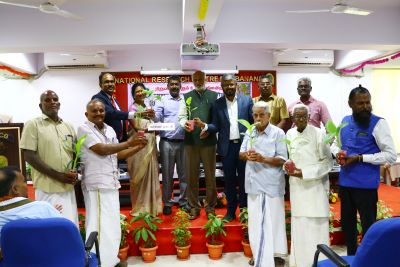
The programme also recognised outstanding contributions of stakeholders through 16 awards, including honours for the Best Banana Farmer, Best Banana Conservator, Best Women Entrepreneur, Best KVK, Best Entrepreneur, Best Banana Exporter and Best Tissue Culture Production Unit. An appreciation award was also presented to Thiru S. Annadurai, Director, Directorate of Tribal Welfare, Tamil Nadu, for his contribution to the welfare of tribal communities.
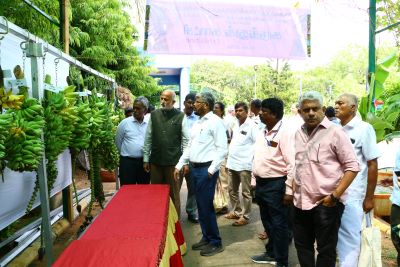
The event witnessed participation from about 1,000 farmers and stakeholders, including farmer organisations such as Senassanjahtna FPO, Mysuru; CIAE, Coimbatore; and Bharathi Kisan Sangam, Solavanthan. More than 32 exhibition stalls showcased technologies, products, innovations and other initiatives related to banana cultivation and allied agricultural activities.
The programme featured panel discussions on “Super El Niño – Challenges and Mitigation Strategies in Rice, Banana, Sugarcane and Coconut Cultivation” and “Fusarium Wilt Management in Banana Cultivation,” facilitating interaction among farmers, scientists, entrepreneurs and other stakeholders.
The 33rd Foundation Day and Kisan Mela reaffirmed ICAR-NRCB’s commitment to promoting climate-resilient, sustainable and economically viable banana-based cropping systems through varietal innovation, technology development, crop protection, mechanisation and stronger farmer engagement.
(Source: ICAR–National Research Centre for Banana, Tiruchirappalli, Tamil Nadu)


Like on Facebook
Subscribe on Youtube
Follow on X X
Like on instagram