


29 September 2026, Motihari, Bihar
As part of Swachhata Hi Seva (SHS)–2026 / Swachhata Pakhwada, ICAR–Mahatma Gandhi Integrated Farming Research Institute, Motihari organized a Human Chain for Swachhata Awareness today to reinforce the message of cleanliness, sanitation, environmental responsibility and Jan Bhagidari for creating clean and healthy surroundings. Scientists, technical and administrative personnel, contractual workers and other staff members of the institute actively participated in the initiative.
The participants joined hands to form a Human Chain, symbolizing unity and collective responsibility towards cleanliness. The activity conveyed the message that Swachhata is not the responsibility of an individual or institution alone, but a shared responsibility of every citizen. Through the initiative, participants reaffirmed their commitment to maintaining clean workplaces, public spaces and surrounding communities. During the programme, awareness was created on clean and hygienic institutional and public spaces, prevention of littering, proper waste disposal and segregation of waste at source. Participants were encouraged to appropriately separate biodegradable, recyclable and other waste streams and adopt responsible waste-management practices at workplaces as well as in their homes and communities.
Special emphasis was placed on the Reduce, Reuse and Recycle (3R) principles as an important approach towards sustainable waste management. Participants were encouraged to minimize unnecessary consumption, reuse materials wherever feasible and ensure appropriate recycling of recyclable materials. The campaign also promoted reduction of single-use plastics, responsible consumption and adoption of environmentally friendly alternatives.
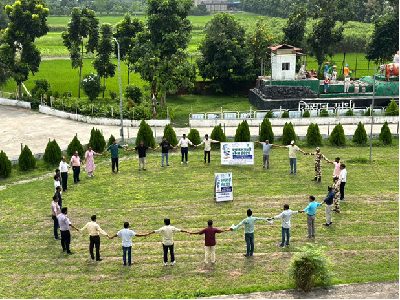
Addressing the participants, Dr Raghavendra Singh, Director, ICAR-MGIFRI, emphasized that cleanliness should become an integral part of everyday behaviour rather than remain limited to periodic campaigns. He highlighted that clean surroundings are closely linked with human health, environmental quality and sustainable development. He called upon institute personnel to lead by example and carry the message of Swachhata from the workplace to their homes and communities.
The Human Chain represents the spirit of unity, behavioural change and Jan Bhagidari, which are central to the Swachhata mission. Participants were encouraged to practise waste segregation at source, minimize waste generation, avoid littering and single-use plastics, and follow the 3R principles in their daily lives. It was emphasized that sustained cleanliness can be achieved only when awareness is translated into regular individual and collective action.
The programme also highlighted the broader objectives of Swachhata Hi Seva, extending beyond routine cleaning to encompass responsible waste management, environmental sustainability, citizen participation and respect for sanitation efforts. Participants reaffirmed their commitment to keeping roads, office premises, public places and community spaces clean and discouraging indiscriminate dumping of waste.
The Human Chain concluded with a collective commitment to keep surroundings clean, practise proper waste segregation, minimize waste generation, promote the 3Rs and motivate others to participate in cleanliness activities.
Through the initiative, ICAR-MGIFRI reaffirmed its commitment to Swachhata Hi Seva and the Swachh Bharat Mission, conveying the message that “Swachhata is Everyone’s Responsibility” and that sustained Jan Bhagidari is essential for building a clean, healthy, environmentally responsible and Viksit Bharat.
(Source: ICAR–Mahatma Gandhi Integrated Farming Research Institute, Motihari)


Like on Facebook
Subscribe on Youtube
Follow on X X
Like on instagram