


For 47-year-old Smt. Manju Devi of Madhubani village in Mithoura block of Maharajganj, Uttar Pradesh, farming was once largely a traditional livelihood sustained through hard work, manual labour and limited resources. With a four-acre farm and a family of six, she played a significant role in farm and household activities, yet her contribution did not always translate into higher income, greater control over resources or a meaningful role in production and financial decisions. Like many rural women, she shouldered multiple responsibilities from crop production and vegetable cultivation to livestock management and household work while facing the challenges of drudgery, limited access to improved technologies and inadequate technical guidance.
Her journey began to change with the intervention of Krishi Vigyan Kendra (KVK), Basuli, Maharajganj, under ICAR-Agricultural Technology Application Research Institute, Kanpur, Zone III. The KVK adopted an integrated approach that combined improved crop production, vegetable cultivation, scientific dairy management, skill development and enterprise diversification, enabling her family to gradually move from a conventional farming system towards a more diversified and resilient livelihood model.
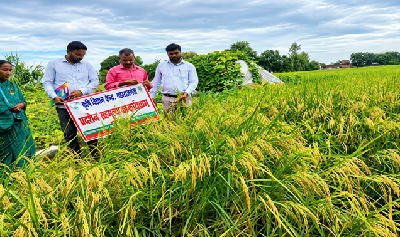
The intervention began with strengthening the foundation of her farm through improved technologies and scientific practices. Front Line Demonstrations (FLDs) on improved rice and wheat varieties introduced better quality seed, improved crop establishment, balanced nutrient management, weed management and scientific crop production practices. Alongside this, machan-based vegetable cultivation was introduced, particularly for cucurbit crops. The technology enabled better utilisation of vertical space while improving aeration and light interception, reducing fruit contact with soil and making intercultural operations and harvesting easier.
Livestock, another important component of the household’s livelihood, was also brought under scientific management. Through training on balanced ration formulation and cattle feeding, Manju Devi learned to provide green fodder, dry fodder, concentrates, minerals and clean drinking water according to the nutritional requirements of the animals. Training in cattle husbandry, animal hygiene and basic livestock care further strengthened her ability to manage the dairy enterprise scientifically.
What began as a series of technology demonstrations and skill-development interventions gradually evolved into a broader transformation of the farm. The number of dairy animals increased from two to eight Gir cows, while the area under vegetables expanded from 0.20 acre to 0.50 acre. The area under rice and wheat also doubled from 1.5 acres to 3 acres. Along with the expansion in farm enterprises came significant improvements in productivity. Vegetable productivity increased from 8 to 12 tonnes per hectare, while rice and wheat productivity rose from 4.0 to 5.0 tonnes per hectare.
The impact was not limited to production. As the farming system became more diversified and organised, the family’s annual enterprise income increased from ₹1.44 lakh to ₹3.15 lakh an additional ₹1.71 lakh. The expansion of productive activities also increased employment generation from about 370 to 670 person-days annually, creating 300 additional person-days of employment. Although the cost of production rose from ₹81,000 to ₹1.75 lakh with the expansion and intensification of enterprises, the overall livelihood portfolio became more productive and diversified.
One of the most significant changes, however, was felt in Manju Devi’s own daily life. The time spent on farm and related activities declined from eight hours to 5.5 hours a day, representing a 31% reduction. The physical strain associated with farm work also shifted from high to moderate/low, indicating a substantial reduction in drudgery. Scientific practices and improved technologies not only enhanced productivity but also helped make farm work more manageable.
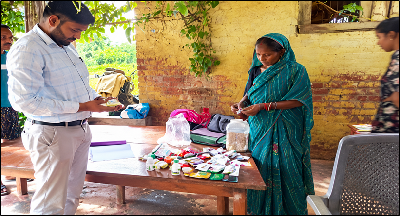
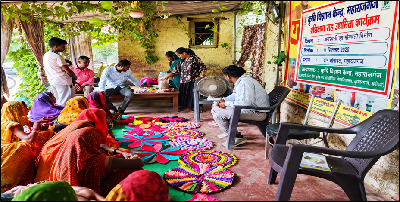
The transformation extended beyond agriculture. Recognising the importance of multiple income streams, KVK interventions encouraged Manju Devi and other women to explore non-farm enterprises. She took up agarbatti and door-mat making, adding two new livelihood activities to the family’s income portfolio. These enterprises opened another avenue for women to participate in income generation while making productive use of their skills and available time.
As her knowledge and confidence grew, so did her role within the household and community. She began participating more actively in decisions related to crop selection, purchase of inputs, livestock feeding, marketing and household expenditure. Her interaction with agricultural experts, input suppliers, markets and fellow farmers increased, and she became more confident in managing resources and planning farm activities.
Her progress also inspired other women. Through Self-Help Group activities, KVK training, FLDs and farmer-to-farmer dissemination, the practices adopted on her farm gradually reached neighbouring households. Around 30 women benefited from training, while the enterprises and improved practices spread to nearly 8–10 villages. From being a farmer with limited access to technical knowledge, Manju Devi gradually emerged as a resource person for other women, sharing her experiences and encouraging them to adopt improved agricultural and livelihood practices.
Her achievements have received wider recognition as well. She has been recognised as a Lakhpati Didi and a Shakti Yoddha under Mission Shakti Abhiyaan, and has been acknowledged as a successful entrepreneur under the National Rural Livelihood Mission (NRLM). She has also served as a Vidhyut Sakhi and received an Excellent Work Award under NRLM.
The story of Smt. Manju Devi is therefore not simply a story of higher farm productivity or increased income. It is a story of how technology, knowledge, skills and institutional support can gradually change the role of a rural woman from a contributor to farm activities to an active decision-maker, entrepreneur and resource person for her community.
Her four-acre farm has become a diversified livelihood system where crops, vegetables, dairy and non-farm enterprises complement one another. More importantly, the transformation has extended beyond her own household. The knowledge she gained is being shared with other women, the enterprises have spread to neighbouring villages, and her experience is encouraging greater participation of women in livelihood activities.
Manju Devi’s journey demonstrates the potential of integrated livelihood models to create not only better farms, but also stronger families, empowered women and more resilient rural communities. With the right combination of technology, skills, enterprise diversification and sustained institutional support, a small farm can become the foundation of a larger transformation one in which women are not merely participants in agriculture, but confident farmers, entrepreneurs, decision-makers and catalysts of change.
(Source: ICAR-Agricultural Technology Application Research Institute, Kanpur)


Like on Facebook
Subscribe on Youtube
Follow on X X
Like on instagram