


How diversification, livestock integration and resource recycling transformed a traditional coconut farm into a more resilient source of food and income
In the remote island setting of Car Nicobar, where farming is largely rain-dependent and access to agricultural inputs and markets can be challenging, diversification can make a significant difference to a farm family's livelihood. For Mrs. Felicia of Tamaloo village, this change began with a simple shift from depending predominantly on coconut and copra to making the most of every available farm resource.
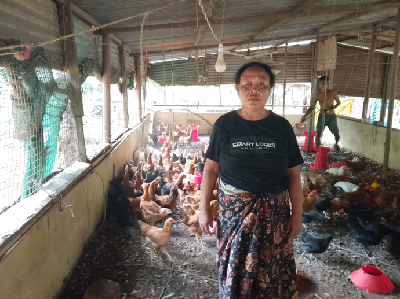
Today, her approximately 1,200 m² farm is a diversified Integrated Farming System (IFS), bringing together vegetables, fruits, coconut and copra, piggery, poultry and goat farming. The transformation has not only opened up additional income opportunities but has also strengthened household food and nutritional security.
Most significantly, the reported net farm income has increased from ₹14,000 before the intervention to ₹1,13,000 after diversification.
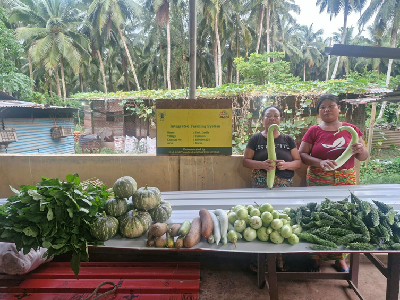
From a Single Source of Livelihood to a Diversified Farm
Car Nicobar receives nearly 3,000 mm of rainfall annually, yet farming remains largely dependent on rainfall due to limited irrigation facilities. The island's sandy to sandy-loam soils also require careful management of available resources. For generations, coconut has been closely associated with the livelihoods of Nicobarese communities, and copra has provided an important source of income that can be stored and sold when required.
Mrs. Felicia, 49, was traditionally dependent on coconut cultivation and copra production, with only limited vegetable cultivation, mainly for household consumption. While this provided an established source of livelihood, the farm had little diversity and therefore offered limited alternatives for both income and food.
With technical guidance, improved planting material, training and hands-on support from ICAR-KVK, Nicobar, Mrs. Felicia gradually began introducing new crops and livestock enterprises while retaining coconut and copra as the foundation of her farm.
The result was not simply an increase in the number of farm activities. It was the creation of an integrated system in which different enterprises complement one another—crops provide food and income, livestock adds new sources of production, and animal waste returns to the farm as organic manure.
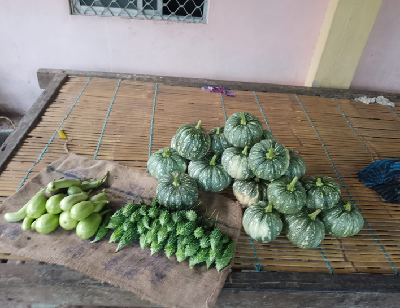
Growing More, Eating Better
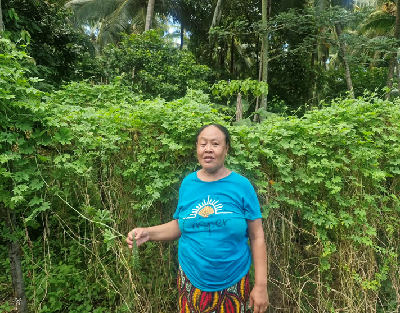
One of the most visible changes was the expansion of vegetable cultivation. Mrs. Felicia introduced crops such as okra, brinjal, bitter gourd, chilli, beans and cucumber, along with fruit crops including banana, papaya and pineapple.
What began as a livelihood intervention also became a nutritional intervention.
Fresh vegetables and fruits produced on the farm are regularly incorporated into the family's meals, increasing the availability and variety of farm-produced food. Surplus produce can be sold in local markets, creating an additional source of cash income.
Thus, the diversified crop component serves a dual purpose: putting nutritious food on the family's table while creating opportunities to earn from the surplus.
This shift is particularly valuable in a remote island environment, where producing a wider range of food on the farm can reduce dependence on purchased produce.
When Livestock Becomes Part of the Farm Cycle
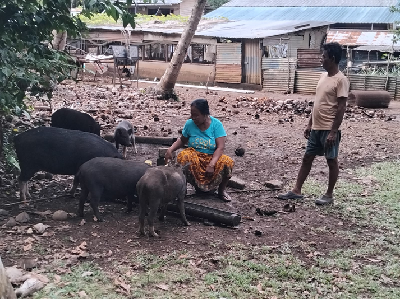
The transformation did not stop with crops. Mrs. Felicia integrated pigs, poultry and goats into the farming system, adding new sources of food and income.
Piggery contributes meat and income, poultry provides eggs and meat, while goats add another livestock-based enterprise. Together, these activities provide additional livelihood opportunities and enable better use of family labour and available farm resources.
An important feature of this integration is what happens to the livestock waste.
Instead of being treated simply as waste, animal manure is recycled as organic manure for crop production. This closes part of the nutrient cycle within the farm, helps return nutrients to the soil and reduces dependence on externally purchased inputs.
In this way, one enterprise supports another livestock contributes to crop production, while crop production and the farm environment support livestock rearing.
Coconut Remains the Foundation
Diversification has not meant moving away from the farm's traditional strength.
Coconut and copra continue to remain important sources of livelihood for Mrs. Felicia. The farm continues copra production using traditional drying practices, while there is scope for adopting improved drying technologies to enhance copra quality and potentially improve market value.
The approach, therefore, is not about replacing coconut with new enterprises. It is about building a wider livelihood base around an existing and well-adapted farm resource.
For coconut-growing households in island environments, such an approach can provide additional sources of food and income while retaining the crop that has long supported the local farming system.
From ₹14,000 to ₹1.13 Lakh: The Economic Transformation
The economic impact of the intervention is reflected in the farm's reported returns.
Before the intervention, plantation with copra drying was the principal enterprise. With a gross cost of ₹7,000 and a gross return of ₹20,000, the reported net income was ₹14,000, with a B ratio of 2.0.
Following diversification, the farm incorporated pumpkin (Kashi Harit), brinjal (Dweep CIARI-1), chilli (Arka Meghana), bitter gourd (Arka Vikas), beans (Arka Mangala), cucumber (Faizabad-1), plantation with copra drying, piggery and poultry and goat farming.
Together, these enterprises recorded a reported gross cost of ₹55,000 against a gross return of ₹1,68,000, resulting in a net return of ₹1,13,000 and a B ratio of 2.05.
Farm Status Gross Cost Gross Return Net Return B Ratio
Before intervention ₹7,000 ₹20,000 ₹14,000 2.00
After intervention ₹55,000 ₹1,68,000 ₹1,13,000 2.05
Among the diversified enterprises, piggery contributed a reported net return of ₹28,000, while poultry and goat farming together contributed ₹23,000. Plantation with copra drying generated ₹19,000, while the different vegetable enterprises added further returns.
The figures illustrate how bringing several complementary enterprises together can expand the economic contribution of a relatively small farm.
A Farm That Produces Food, Income and Farm Inputs
The real significance of Mrs. Felicia's transformation extends beyond income.
Earlier, the farm was primarily a source of earnings through coconut and copra. Today, it serves several functions at once it produces food for the family, generates income, supports livestock and recycles nutrients back into the soil.
This creates a closer relationship between production and consumption. Vegetables and fruits can be consumed fresh, eggs and livestock products contribute to household food availability, and surplus farm produce can be marketed.
At the same time, livestock manure is returned to crop production as organic manure. Farm resources are therefore used more efficiently, while waste from one component becomes an input for another.
Such integration can also help distribute production risks. Instead of relying on one major commodity, the family has multiple sources of food and income across different farm enterprises.
A Model with Potential Beyond One Farm
Mrs. Felicia's experience offers a practical example of how a traditional coconut-based farming system can evolve without losing its existing strengths.
The farm's diversification has created opportunities for income generation, improved access to farm-produced food and better resource utilization. It has also provided a visible example for neighbouring farmers, particularly women and youth, demonstrating that even under the geographical and resource constraints of Car Nicobar, a small farm can support multiple complementary enterprises.
The farm thus has potential to serve as a local demonstration point where farmers can observe crop diversification, livestock integration, nutritional gardening and resource recycling in practice.
ICAR-KVK, Nicobar: Enabling the Transformation
At the heart of this change has been the support provided by ICAR-KVK, Nicobar.
Through technical guidance, improved planting material, training and field-level support, the KVK helped Mrs. Felicia move from a predominantly coconut-based system towards a more integrated farm model.
Importantly, the intervention was not centred on a single crop or technology. It brought together crop diversification, nutritional gardening, livestock integration, resource recycling and improved management of the existing coconut-based enterprise according to the farm family's available resources.
Such field-based extension is particularly relevant in remote regions, where locally appropriate technologies and continuous farmer–scientist interaction can play an important role in strengthening farm livelihoods.
A Small Farm, A Bigger Possibility
Mrs. Felicia's farm at Tamaloo village reflects a larger lesson for farming communities in remote island regions: resilience can begin with diversification.
From a farm largely dependent on coconut and copra, her holding has evolved into an integrated system combining vegetables, fruits, livestock and traditional coconut production. The reported increase in net income from ₹14,000 to ₹1,13,000 represents the economic dimension of this transformation. Equally important are the gains in household food availability, nutritional diversity and resource recycling.
With continued technical support and scope for improved copra drying and further strengthening of livestock enterprises, the experience offers potential for wider adoption in similar farming situations across Nicobar.
What began as a move to grow more has evolved into something larger—a farm that produces more food, creates more livelihood opportunities, uses its resources more efficiently and builds greater resilience through integration.
For Car Nicobar's farming communities, Mrs. Felicia's journey offers an encouraging example of how integrated farming can turn limited resources into diverse opportunities for a more secure and sustainable livelihood.
(Source: ICAR–Central Island Agricultural Research Institute, Sri Vijaya Puram)


Like on Facebook
Subscribe on Youtube
Follow on X X
Like on instagram