


28 September 2026,Farakka
ICAR-Central Inland Fisheries Research Institute, Barrackpore, in association with the Farakka Barrage Authority (FBA), Ministry of Jal Shakti; NTPC Farakka; and CISF, Farakka, organised a Fish Ranching Programme in the River Ganga at Farakka today.
The programme, conducted under the leadership of Dr Pradip Dey, Director, ICAR-CIFRI, aimed to strengthen indigenous fish diversity, restore aquatic biodiversity and promote sustainable fisheries management in the River Ganga, in alignment with the objectives of the Sustainable Development Programme and the National Mission for Clean Ganga (NMCG). The programme brought together senior officials and stakeholders representing different organisations working towards the sustainable management of the River Ganga.
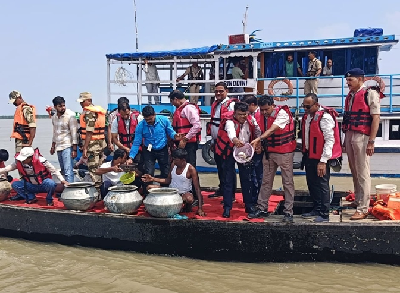
Reflecting on the occasion, Dr Dey emphasised that conservation of the Ganga’s biodiversity must move beyond isolated interventions and evolve into a sustained, science-based and participatory movement. He highlighted that the Ganga is not merely a river but a living ecological system, whose health is closely linked with aquatic biodiversity, fisheries and the livelihoods of millions of people. He observed that fish ranching, when supported by scientific monitoring, habitat conservation and active community participation, can serve as an important tool for restoring native fish populations and enhancing the ecological resilience of the river. He further underscored the need for a collective vision to restore the Ganga as a healthy, biodiverse and productive river system where ecological conservation and sustainable livelihoods progress together. He reaffirmed the commitment of ICAR-CIFRI to work collaboratively with all stakeholders in transforming such initiatives into a sustained and long-term movement for biodiversity conservation and ecological restoration of the Ganga.
Welcoming the dignitaries, the ecological significance of fish ranching for strengthening natural fish populations and conserving indigenous fish diversity in the Ganga River system was highlighted. The importance of scientific breeding, seed production, and stocking of indigenous Gangetic fish species for sustaining riverine fisheries and supporting the livelihoods of fishing communities was also emphasized.
The delegates also visited the hatchery facility, where the operational aspects of the FRP carp hatchery, including fish seed production and fingerling management for ranching programmes, were explained. As a major conservation intervention, 30,000 fingerlings of Indian Major Carps (IMC) were ranched into the River Ganga at Farakka.
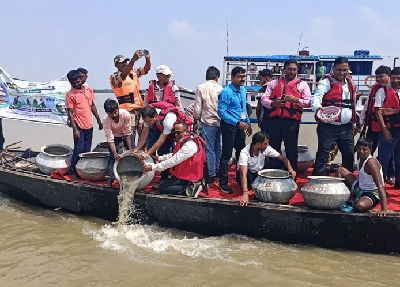
The participation of senior officials from NTPC Farakka, Farakka Barrage Authority and CISF reflected a strong spirit of inter-institutional cooperation for conservation and sustainable management of the fisheries resources of the River Ganga. Representatives of FBA, NTPC and CISF expressed their commitment to extending support to similar initiatives in the future as part of the Biodiversity Conservation Plan.
The programme also witnessed the participation of more than 20 active fishermen dependent on the River Ganga, highlighting the importance of involving local fishing communities in conservation initiatives. Their participation reinforced the principle that sustainable restoration of riverine biodiversity must be closely linked with the livelihood interests and knowledge of communities dependent on aquatic resources.
The fish ranching initiative represents a collaborative step towards achieving the objectives of the National Mission for Clean Ganga and Sustainable Development, while promoting conservation of indigenous fish diversity and sustainable fisheries in the Ganga basin.
(Source: ICAR-Central Inland Fisheries Research Institute, Barrackpore)


Like on Facebook
Subscribe on Youtube
Follow on X X
Like on instagram